

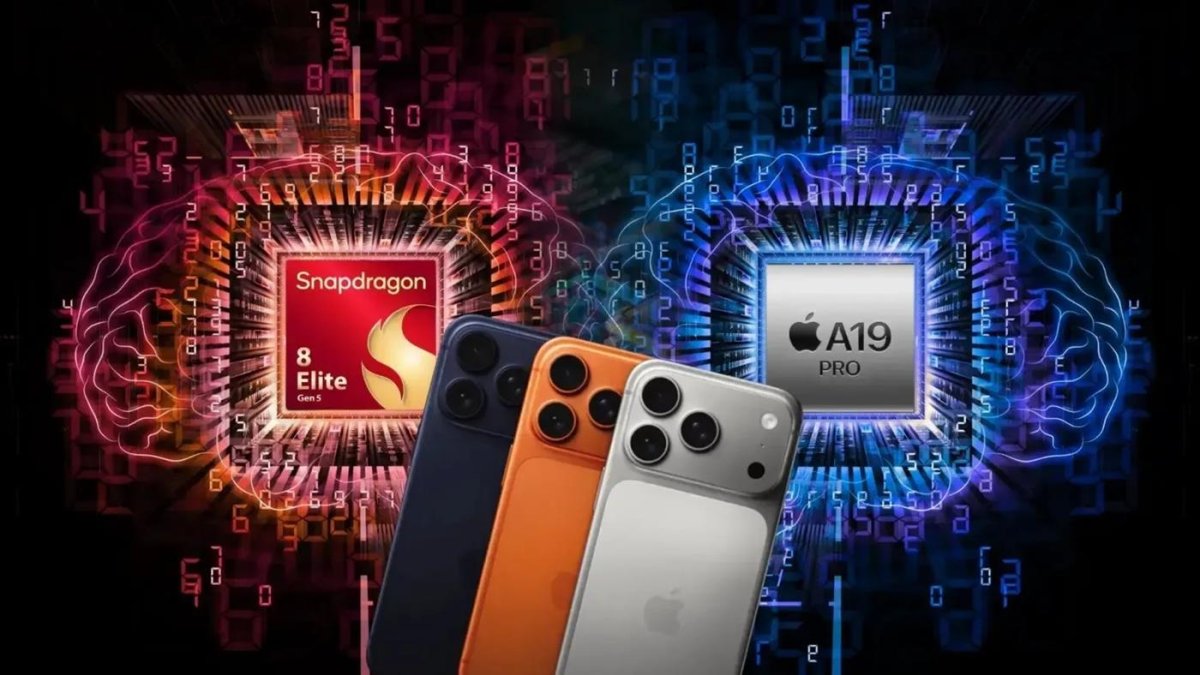
As competition among smartphone processors increases every year, developers' focus has begun to shift not only to raw performance but also to efficiency and performance metrics. Recently, the GPU and CPU results of Exynos 2600, Snapdragon 8 Elite Gen 5, and Dimensity 9500 were discussed. Finally, the IPC (instructions per clock cycle) performance for three flagship processors has been shared.
Redaksiya reports that Apple A19 Pro is presented as a leader in efficiency. The information notes that a CPU cycle refers to the process a processor follows to execute a command, and this process consists of the stages of Data Fetch (retrieving data from memory), Instruction Decode (interpreting), Execute (processing), and Write Back (writing the result to memory). According to the latest shared data, the US company's Apple A19 Pro model surpasses its competitors in terms of IPC (instructions per clock) metric, meaning the number of commands processed per clock cycle. This metric is considered critical in terms of architectural efficiency because it shows how much work a processor can do at the same frequency. Based on the data, the A19 Pro can process approximately 0.89 commands in a single clock cycle. This figure remains at 0.79 for the Dimensity 9500, with a difference of approximately 13%. By the same logic, the A19 Pro appears to be approximately 10% more efficient compared to the Snapdragon 8 Elite Gen 5, and approximately 6% more efficient compared to the Exynos 2600.
It is emphasized that these results indicate Apple's advantage comes not only from frequency or core power but directly from its architectural design. An interesting detail emerges on the Exynos 2600 side: despite using the same ARM-based core, the Exynos 2600 achieves an approximately 6% higher IPC value compared to the Dimensity 9500. Moreover, this difference is achieved despite a lower clock speed. The information notes that memory efficiency and cache capacity could be the reason for this difference.