

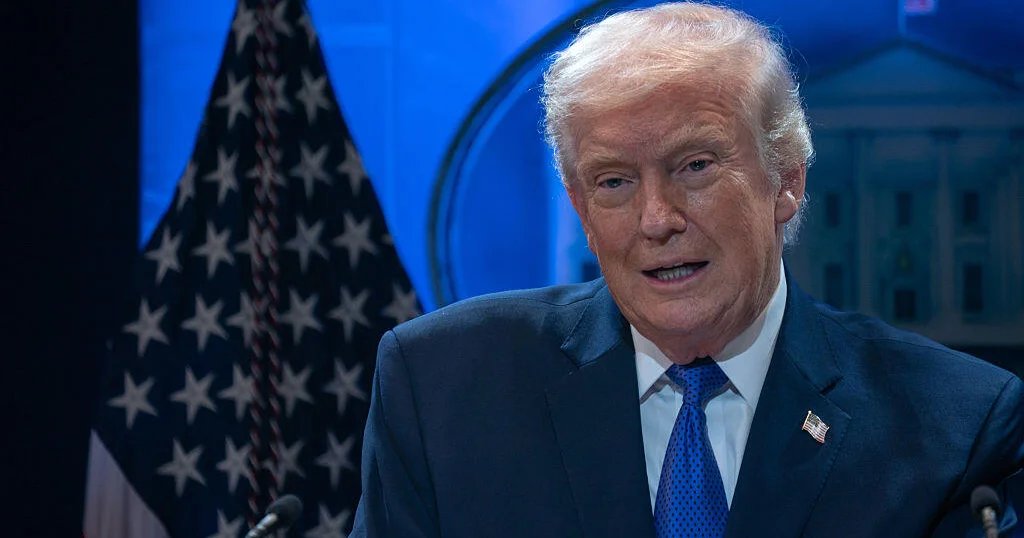
U.S. President Donald Trump announced on Saturday that he will raise global tariffs to 15% following a Supreme Court decision. This was reported by CBS News correspondent Lucia Suarez Sang.
Redaksiya reports that U.S. President Donald Trump stated he would raise his global tariff to 15% after imposing a 10% tariff on Friday. In a social media post, Trump stated he made this decision based on a "detailed, thorough, and complete review of the ridiculous, poorly written, and extremely anti-American tariffs decision made by the U.S. Supreme Court yesterday."
"Please be advised that as President of the United States, I will be raising the 10% Universal Tariff, which has been applied to countries that have been 'ripping off' the U.S. with impunity for decades (until I came along!) to a fully permissible and legally tested 15% level," he wrote in a Truth Social post. Enraged by the court's decision, Trump signed a proclamation on Friday, bypassing Congress, to impose a 10% tax on most imports into the U.S. The law allows the president to impose tariffs of up to 15% for a period of 150 days, although this may face legal challenges. Trump later stated that his administration would identify and issue new, legally permissible tariffs to continue our process of 'Making America Great Again.' Most of the president's previous taxes were based on a law called the International Emergency Economic Powers Act, or IEEPA, which the Supreme Court ruled could not be used to impose tariffs on Friday. The tariffs imposed on Friday were based on Section 122 of the Trade Act of 1974. This legal provision allows the president to impose duties of up to 15% for 150 days to address 'large and serious' balance of payments problems. They are scheduled to take effect on February 24th. It was not immediately clear when the president would sign his renewed order. In addition to the temporary tariffs Trump wants to set at 15%, the president stated on Friday that he is also seeking to impose tariffs through other sections of federal law that require an investigation by the Department of Commerce. The Supreme Court's decision did not affect tariffs imposed by legal bodies other than IEEPA, including tariffs Trump imposed on steel, aluminum, and automobile imports.