

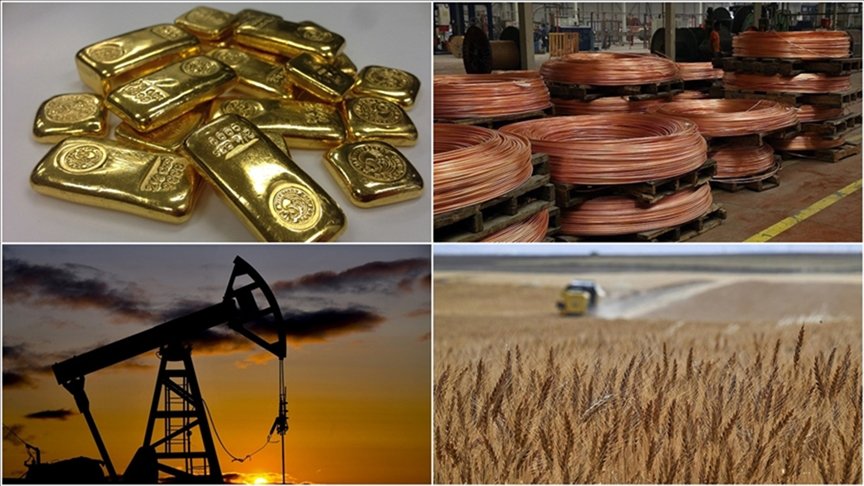
Tensions between the US and Iran, along with uncertainties surrounding the Trump administration's tariff policies, dominated commodity markets this week. Gold rose 1.4% and Brent crude gained 6% due to safe-haven demand, while natural gas fell 7.2%.
Redaksiya reports that expectations of interest rate cuts by the US Federal Reserve (Fed) supported risk appetite in commodity markets, particularly for precious metals.
Analysts state that despite a divergence in policy among Fed members seen in the meeting minutes, the possibility of an interest rate cut remains if inflation slows in line with expectations.
On the geopolitical front, US President Donald Trump's 10-day ultimatum for resolving the Iran issue and the emergence of the risk of potential military intervention supported oil prices while increasing demand for safe-haven assets.
Supply concerns originating from the Middle East led to volatile price movements in Brent crude, as investors' attention turned to political developments.
On the other hand, the US Supreme Court's ruling that the International Emergency Economic Powers Act (IEEPA), which the Trump administration used to justify additional tariffs, does not grant the president the authority to impose tariffs, increased uncertainty in commodity markets regarding trade policies and affected valuations.
Analysts stated that the subsequent opening of the legal basis for tariffs to discussion increased volatility, especially in industrial metals and commodities sensitive to global trade.
US President Donald Trump's announcement of plans for temporary global tariffs under Section 122 of the Trade Act of 1974 indicated that uncertainty could continue for some time.
Macroeconomic indicators were also closely monitored by investors, with the US economy growing by 1.4% in the fourth quarter of 2025, below expectations. The country's economy showed an overall growth performance of 2.2% for the entirety of 2025.
Furthermore, an acceleration was observed in the data considered by the Fed as an inflation indicator. Accordingly, the core personal consumption expenditures price index, excluding food and energy items, increased by 0.4% month-on-month and 3% year-on-year in December last year, exceeding expectations. The index had increased by 0.2% month-on-month and 2.8% year-on-year in November last year.
Following these developments, the US 10-year Treasury yield closed the week at 4.09%, while the dollar index rose by 0.9% to 97.8.
With these developments, the price of a barrel of Brent crude increased by 6% on a weekly basis, while the price of natural gas, traded on the New York Mercantile Exchange in British Thermal Units (MMBtu), lost 7.2% in value.