

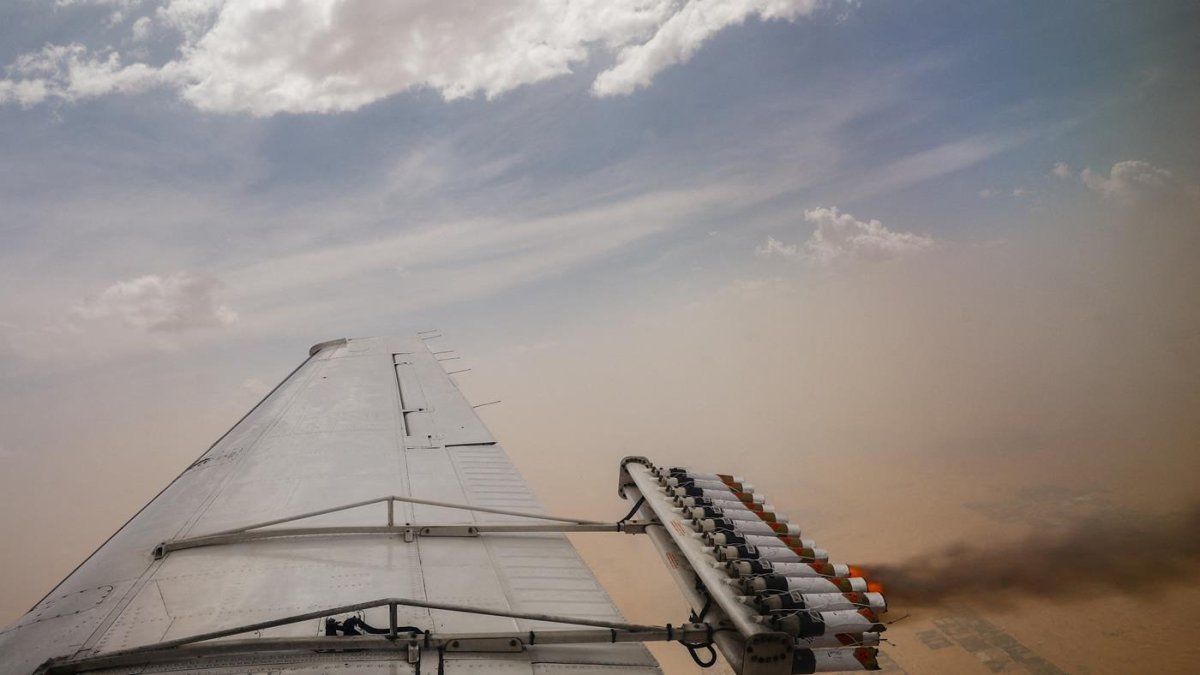
Amidst global warming and climate change, the impacts and concerns of a global water crisis are escalating. According to the United Nations, a period of 'global water bankruptcy' has begun, prompting countries to turn to cloud seeding, a method of artificial rain. Alongside the US and China, which has the world's largest weather modification program, countries like France, Russia, India, and Saudi Arabia are among those investing in this technology. The main goal is to control the timing and amount of rainfall to some extent. However, this method sparks debate from both scientific and geopolitical perspectives. What is cloud seeding, and how does it work?
Redaksiya reports that cloud seeding is a weather modification technique aimed at enhancing the ability of existing clouds to produce rain or snow. In this method, very small particles, typically silver iodide, are dispersed into clouds. These particles trigger the formation of water droplets or ice crystals, accelerating the rain process. However, this method has limitations. It can only affect existing clouds and is confined to a specific geographical area and timeframe. Long-term assessments suggest it can increase local rainfall by approximately 5% to 15%.
On the other hand, the application of cloud seeding is not new, with its history dating back to the 1940s. Despite this, interest significantly declined in the 1970s and 1980s. The most crucial reason for this was the inability to reliably measure how much rain the intervention actually created. In recent years, thanks to advancements in measurement and impact analysis technologies, the results of operations can be confirmed more accurately. Experts believe there are two main reasons for the renewed interest. Firstly, water resources have become more fragile due to changes in climate and rainfall patterns. This situation compels decision-makers to seek more creative solutions, especially in regions with a high risk of drought. The second important factor is the technical advancements recorded in recent years. Systems capable of measuring the impact of cloud seeding in real-time are increasing the trust of investors and public bodies. An indicator of the growing interest in the sector is the increase in the number of employees at Rainmaker, a US-based company operating in this field, from 19 to 120 in less than a year. The company specifically aims to mitigate the increasing drought in the western United States. Although the company's name refers to rain, a large portion of its projects are focused on producing snow rather than rain. Increased snow cover, especially in mountainous regions, contributes to water supply by feeding reservoirs with meltwater in the spring and summer months.
Cloud seeding applications are used for various purposes. China intervenes in clouds using rockets, as well as airplanes and drones. This method was used to manage rainfall during the 2008 Beijing Summer Olympics. In the United Arab Emirates, clouds are intervened with using salt-based flares, and Saudi Arabia spent $256 million for the first year of its regional program in 2022. China is reported to have supported its weather modification program with approximately $2 billion between 2014 and 2021. India, which implements this method in over 50 countries, also conducted a trial, but the goal was to reduce severe air pollution in Delhi. Despite this objective, success was not achieved because there was insufficient atmospheric moisture to form rain. Nevertheless, a measurable reduction in particulate matter levels was recorded after the experiment. Iran also sprayed chemicals into clouds last year in the Lake Urmia basin to combat one of the most severe droughts of recent decades.
According to researcher Frank McDonough from the Desert Research Institute, scientific studies and cost-benefit analyses conducted in recent decades have enabled decision-makers to use this method more reliably. McDonough emphasizes that cloud seeding can add new water to the system by utilizing natural atmospheric processes, rather than depleting existing surface or groundwater. Particularly, considering that ski resorts are forced to produce artificial snow with collected water, increasing natural snowfall means an additional source for the basin. This, in turn, means accumulating more reserves in the 'water bank' for the next season. Some believe the method can provide a 'moderate increase' but is not a transformative solution. In terms of cost, the additional water is reported to cost between $1 and $10 per hectare-meter. While this amount varies, it is generally much lower compared to desalination methods. Since cloud seeding only works on existing clouds, it is strongly dependent on cloud microphysics. If suitable moisture and temperature conditions are not present, no results are achieved. It remains difficult to determine the exact proportion of the impact attributable to human intervention. The World Meteorological Organization states that there is no strong evidence of significant negative impacts on human health or the environment from past silver iodide projects. However, it is noted that the effects of wind direction require more comprehensive research.
One example where artificial rain applications have yielded specific results is the United Arab Emirates. In a country where average annual rainfall is below 200 millimeters, over $20 million has been invested in cloud seeding research since the early 2000s. In operations coordinated by the National Center of Meteorology in Abu Dhabi, suitable clouds are identified using data from 110 weather stations across the country, and attempts are made to increase rainfall by dispersing salt-based substances into clouds with approximately 1000 flight hours per year. The goal is to support groundwater reserves alongside surface rainfall. This technical intervention is part of a larger 'greening the desert' strategy. Under the 'One Million Trees' initiative launched by the ruler of Dubai, the aim is to plant 250,000 trees annually. Drought-resistant species such as olive, date palm, and the country's national tree, Ghaf, are preferred.