

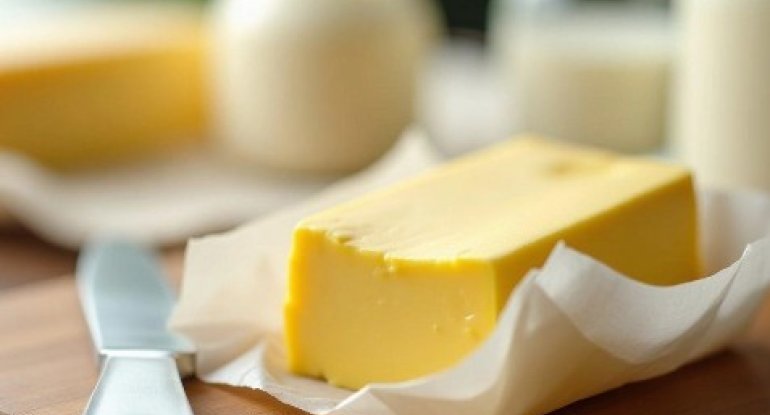
The latest official statistics present a contradictory picture in the butter market. In January-November of last year, 24,358.8 tons of butter were produced in Azerbaijan, marking a 9.4 percent decrease compared to the same period the previous year. However, as of December 1st, it is reported that 179.6 tons of butter reserves have been formed in the warehouses of industrial enterprises. These figures, presented as a 199.6-fold increase year-on-year, raise serious questions about real market abundance. How is such an increase in reserves explained in a situation where production has decreased, and could these reserves, if released to the market, lead to lower prices?
Ölkə.az presents an article from the "Kaspi" newspaper on the topic:
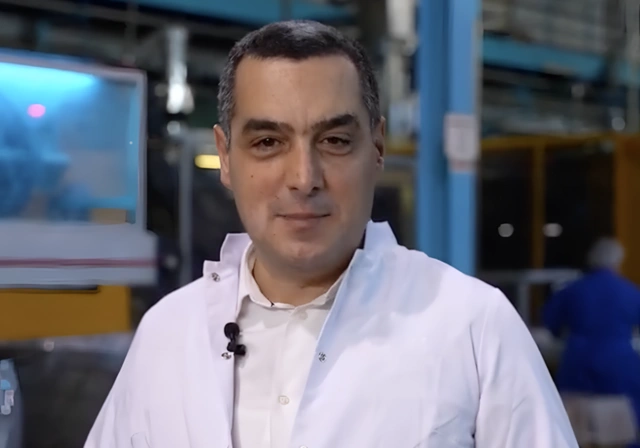
"Local Butter Production is Non-existent"
According to Samir Eyyubov, Chairman of the Association of Dairy Producers and Exporters of Azerbaijan, the production of butter based on local milk in Azerbaijan is practically at a very low level. "The 'production' figures shown in official statistics are mainly formed from products processed from imported cream, as well as the re-packaging or minimal processing of finished products imported in raw form within the country. Therefore, the indicators presented as 'local production' in statistics do not reflect the real market situation and lead to a misanalysis of the market. In reality, dependence on imports for butter is over 90 percent. All the butter available in warehouses is either ready-made imported products or products brought from abroad in raw form and re-processed domestically. Products that can be considered purely local production are practically non-existent."
"Import Price Increased by 18 Percent"
According to S. Eyyubov, looking at the statistics for the first 9 months of 2025, it is evident that the average import price of butter imported into the country has increased by approximately 18 percent compared to 2024. Against the backdrop of this price increase, a decrease of approximately 11 percent in monthly average import volumes has been recorded. "In addition, while approximately 12,000 tons of butter were exported to Russia in 2024, based on the figures for the first 9 months of 2025, this figure has fallen to the level of 2,300 tons. As a result, re-processing volumes have decreased, which has led to a decline in statistical 'production' indicators. The sharp decrease in export volumes to Russia, meaning the narrowing of one of the main sales channels, has created an imbalance in the market, forming the appearance of increased reserves."
"Prices Will Not Go Down, On the Contrary, They Will Go Up"
The chairman also discussed how this process will affect producers. "Keeping reserves in warehouses for a long time means significant financial losses for producers. This leads to a decrease in the product's shelf life, circulation and liquidity problems, and consequently, an increase in repeated financial losses. The existing reserves are already approximately 18 percent more expensive than in 2024. Moreover, from the first days of 2026, the import duty is expected to be raised back to 15 percent. These factors may lead to significant price increases in the market, rather than a decrease. Companies may be forced to implement price increases of an average of 9-10 percent."

"The Increase in the Cost Price of Milk Affects Butter Prices"
Jafar Ibrahimli, an expert on agricultural issues, disagrees with the presented figures. "It is assumed that other fat products, in addition to butter, have been included in the calculations, which could cause discrepancies in the indicators."
According to J. Ibrahimli, the price of butter has significantly increased in 2025. "In parallel, an increase in the exit price of milk from farms is also observed, mainly due to increased feed costs and production cost price. The increase in the cost price of milk has directly affected the selling price and, consequently, the price of butter. In the current situation, a decrease in prices is not expected in the near future, as demand remains high."
"Sufficient Potential Exists"
The expert sees a decrease in prices in increasing local production. "At the same time, Azerbaijan has sufficient potential to increase butter production. However, currently, a synchronized cooperation mechanism between farmer households and processing enterprises is not properly established. This mismatch creates problems in the production chain and increases the country's dependence on imports. If proper coordination and support mechanisms are formed, it is possible to increase domestic production, which could lead to price stabilization in the medium term."

"The Figures Indicate Weakening Sales"
Economist-expert Gunay Huseynova believes that the main reason for the increase in reserves against the backdrop of decreased butter production is related to imported alternative products, especially margarine and other composite fats. "Since these products are more budget-friendly for the buyer in terms of price, demand is mainly directed towards them. Although butter has its own buyers, demand does not expand due to price, and as a result, the product remains in warehouses. The abundance of products in reserve warehouses does not automatically mean real market abundance or a decrease in prices. We can only talk about market abundance when there is demand for the product and its price is formed at an accessible level for the buyer. In this regard, we are talking about real abundance for the warehouse, not for the consumer. In the real economic environment, this situation indicates weakening sales."