

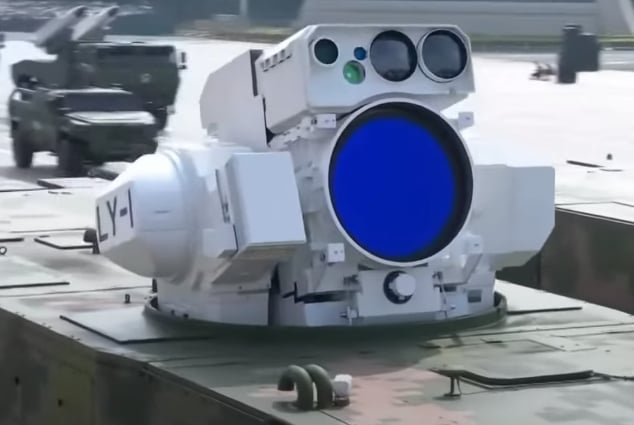
Among the new technologies showcased at the military parade in Beijing, the LY-1 ship-borne laser system attracted the most attention. Chinese media reports that this weapon could "change the rules of naval warfare" by disabling the optical sensors of enemy targets, from unmanned aerial vehicles to cruise and anti-ship missiles.
The editorial staff reports that the LY-1 was first presented on an eight-wheeled mobile carrier, indicating its potential application on land platforms as well. Although the system's power specifications have not been disclosed, some sources mention an output power of at least 50 watts. Its large main lens beam director, along with additional electro-optical and infrared sensors, is designed for target detection and tracking. Additional modules house systems that enhance targeting accuracy. It is reported that Chinese scientists made progress in cooling mechanisms, essential for long-term operation, in 2023. The biggest advantage of the LY-1, unlike missiles with limited ammunition, is its extremely low firing cost and its ability to operate as if possessing "unlimited ammunition."
The main reason for Western concern is that this technology further strengthens China's "anti-access/area denial" (A2/AD) capabilities. According to military experts, the laser system could undermine the containment policy implemented by the US in the Asia-Pacific region. "The War Zone" publication described the LY-1 as a "highly in-demand defense system," while "Daily Mail" called it "Star Wars technology," presenting it as a weapon that "could overturn the West's dominance over the international order."
"Defence Security Asia," emphasizing that the laser is ready for mass production, called it a "game-changing, photon-age threat" for the US and its allies. According to the publication, the LY-1 embodies a "new paradigm that will shift combat in air, sea, and space domains to the speed of light."