

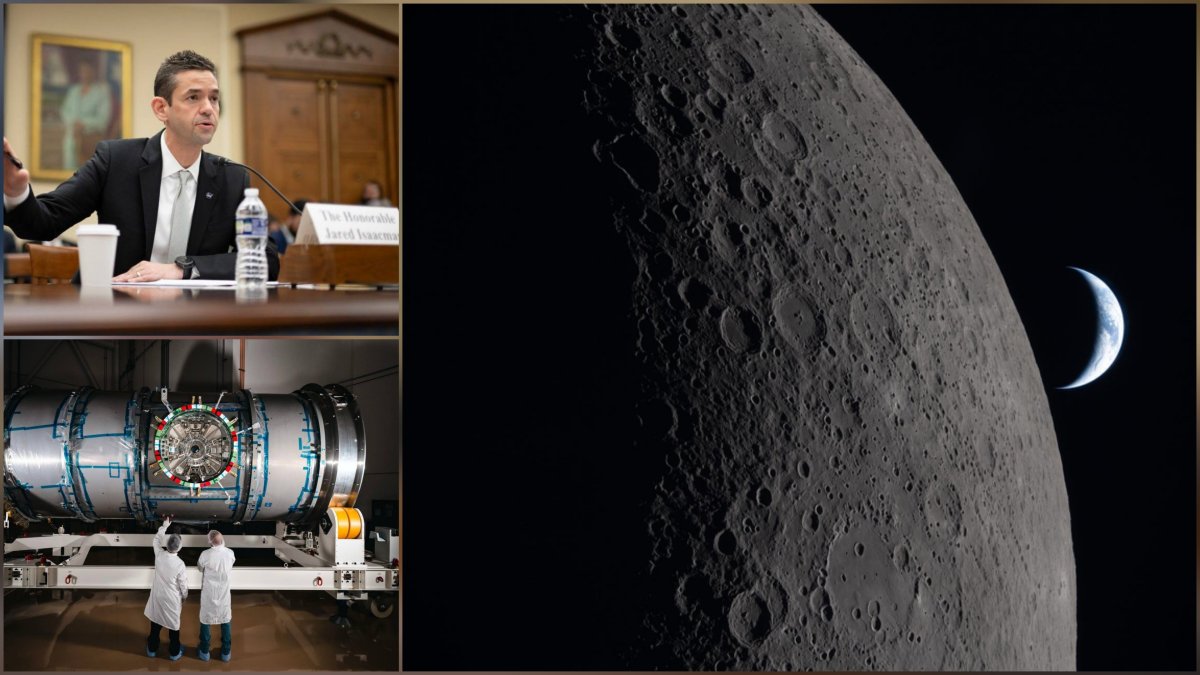
A new technical controversy has emerged surrounding NASA's planned Gateway station in lunar orbit. Gateway is a small orbital station intended for the Artemis Lunar program, led by the U.S. space agency NASA. This station was meant to serve as a stopover and habitat for astronauts on their lunar surface landing missions.
The editorial board reports that NASA head Jared Isaacman, speaking before the U.S. Congress, stated that there is a corrosion problem in the habitat modules being prepared for Gateway. Corrosion is the damage to metal, meaning its rusting and loss of quality, due to oxidation, humidity, or other chemical effects. This problem has primarily been observed in two modules: HALO and I-HAB.
HALO is an acronym for “Habitation and Logistics Outpost.” This is the main habitation and logistics module belonging to the U.S. side of the Gateway station. In other words, it is intended for astronauts' temporary living, equipment storage, and a portion of the station's control functions. In 2021, NASA signed a $935 million fixed-price contract with the U.S. company Northrop Grumman for the development of HALO. Northrop Grumman is a major U.S.-based defense and aerospace company.
HALO's pressurized hull, however, was developed at Thales Alenia Space, located in Italy. A pressurized hull refers to the main metal “body” that maintains air pressure inside a space module, allowing astronauts to breathe. Thales Alenia Space is a French-Italian space manufacturer, with France's Thales company owning 67 percent and Italy's Leonardo company owning 33 percent.
The second problematic module is called I-HAB. This is an acronym for “International Habitation Module” and is a habitat module developed for Gateway by the European Space Agency. ESA stands for European Space Agency; this organization coordinates Europe's space programs and has 23 member states. I-HAB is intended to provide additional living space for astronauts, control capabilities, and docking points for the station.
In 2020, ESA signed a 327 million euro contract with Thales Alenia Space for the development of the I-HAB module. Thus, the same company — Thales Alenia Space — is involved in the production of both HALO's hull, belonging to the U.S. side, and the I-HAB module, belonging to the European side.
According to European Spaceflight, ESA has confirmed the presence of corrosion traces on the HALO and I-HAB modules. The agency also stated that this problem is not the sole cause of delays in the Gateway program. According to ESA's position, other technical issues in the U.S. supply chain have also contributed to the delays.
Thales Alenia Space, however, refrained from using the harsh term “corrosion” and instead called it “a well-known metallurgical behavior.” Metallurgy is an engineering field that studies the structure, properties, and processing of metals. The company's statement effectively suggests that the problem on the metal surface was not unexpected and that similar cases have been encountered before.
Thales has stated that the problem with HALO will be resolved by the end of the third quarter of 2026. This practically increases the likelihood that the module's full readiness could extend to the end of 2026 or early 2027. Work is also underway with ESA to resolve a similar problem with I-HAB, but a specific date for this module has not been announced.
The controversy comes at a time when NASA is re-evaluating its Gateway program. The U.S. side wants to focus more on establishing a base and sustainable infrastructure on the lunar surface rather than building a station in lunar orbit. This poses a serious problem for Europe: one of ESA's main future plans for human spaceflight was precisely tied to the Gateway project.
The issue also creates a reputational risk for Thales. The company has previously participated in the production of modules for the International Space Station and is also involved in module projects for Gateway, the Cygnus cargo spacecraft, and Axiom's future commercial space station. Therefore, such a technical problem is not just a delay of one module but raises broader questions about the reliability of the European space industry.