

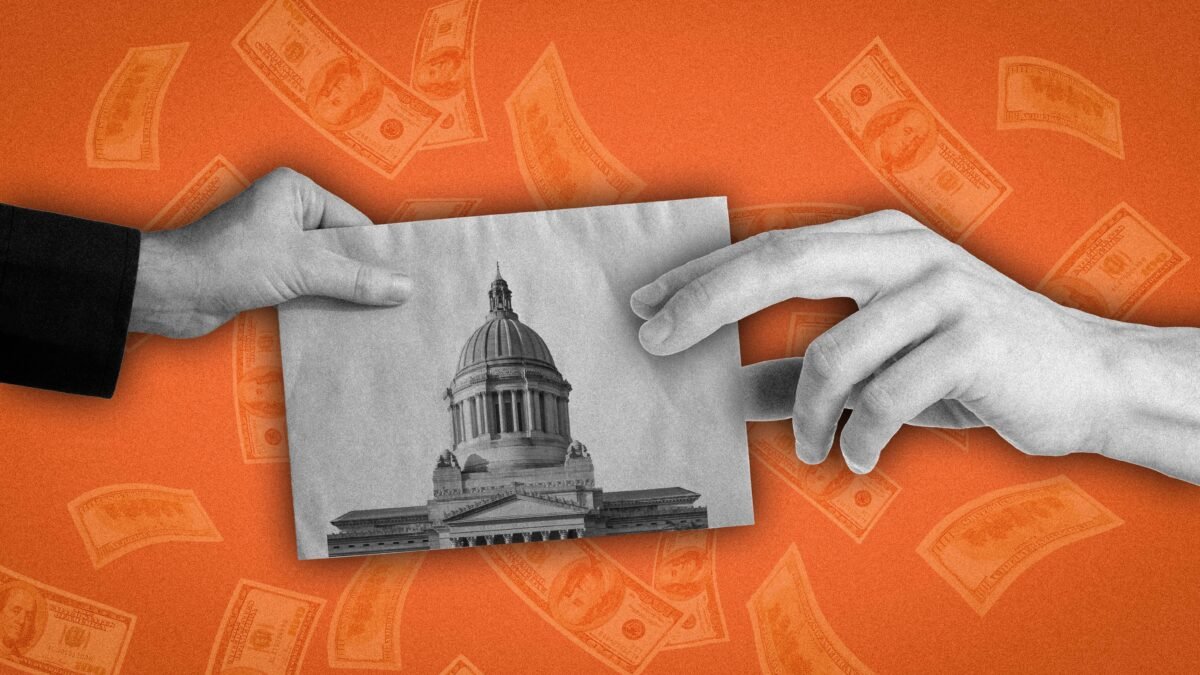
The state of Washington is considering a 9.9 percent tax on income exceeding one million dollars. This move would remove the state from the short list of states without an income tax. Washington has achieved tremendous economic growth for decades, and the absence of state income taxes has led it to host some of the world's largest technology companies (including Microsoft and Amazon). The new measure threatens to change all of that.
Redaksiya reports that the state constitution currently prohibits income tax. It considers income as "property" and the rules for property taxes require its uniform application and limitation to 1 percent (as with traditional property taxes), unless voters approve it by a supermajority vote. Washington imposed a 7 percent tax on long-term capital gains above $250,000 in 2021. This move was made possible by a contentious legal argument that the sale of securities constituted an excise tax on the exchange of capital assets. It is worth noting that the capital gains tax was essentially a law aimed at one person: Jeff Bezos, founder of Amazon, evaded taxes by moving his residence to Florida before the tax came into effect. The newly proposed income tax, Senate Bill 6346, will treat capital gains as income and subject them to both capital gains tax and income tax.
To prevent the tax from being unconstitutional, the state Supreme Court must either overturn this precedent, as established in a 1933 state Supreme Court case (Culliton v. Chase), or recharacterize the millionaires' tax as an excise tax-based property tax. The latter has become even more difficult with the adoption of the capital gains tax, which is based on transactions. The bill includes an "anti-referendum clause" stating that the tax is "necessary for the support of the state government and its existing public institutions," making it difficult to repeal by popular vote. It is also worth noting that three state Supreme Court justices recently retired, allowing Democratic Governor Bob Ferguson to significantly influence the court that will rule on the constitutionality of the tax.
To be fair to the architects of the bill, the tax is not truly a progressive tax, meaning there are no brackets with progressively higher tax rates. It is a flat tax starting from $1 million in income. This tax is framed as a tax that will only affect the wealthy, but it is undeniable that successive governments will implement taxes at lower income levels. The tax, like most new income taxes, will facilitate a truly massive expansion of state government and will ultimately affect all Washington taxpayers, as all income taxes do. The 9.9 percent rate will be one of the highest in the country, lower than California and New York City, but comparable to New Jersey, Minnesota, and Hawaii. This will transition from a low-tax state to a punitively high-tax state overnight.
Georgia, Mississippi, Oklahoma, and Arkansas are working to reduce their state income taxes with the goal of eliminating them entirely. It is no coincidence that these are Republican-dominated states. Rhode Island is in the process of increasing income taxes, as are Virginia and now Washington. It is no coincidence that these are Democratic-dominated states. Red states are lowering taxes, while blue states are raising them. There is a saying in the financial world: Capital flows to where it is best treated. What we have seen since the Tax Cuts and Jobs Act of 2017 is a massive migration of people and capital to low-tax jurisdictions after limitations were placed on the deductibility of state and local income taxes. There is a reason for the skyscrapers rising in Nashville, Miami, and Austin. There is a reason why Florida, Texas, and much of the South are on the receiving end of the migration.
Another saying: There are no controlled experiments in finance. But there are: East and West Germany, North and South Korea, Chile and Argentina, and more recently Poland and the rest of Europe – where low taxes, the rule of law, and property rights enable economic growth and human prosperity. We have a controlled experiment playing out in real-time with red and blue states in the US. On a static basis, blue states still have higher GDP per capita, but red states have higher growth rates and are catching up, while blue states are slowly losing their economic advantages. If New York City Mayor Zohran Mamdani gets his way and raises marginal tax rates in the city to 16.8 percent, capital flight will accelerate, and it is possible that Miami will be the new financial center of the world in 20 years.
As for Washington, the purpose of the millionaires' tax is twofold: punitive justice and revenue generation. If passed, it will succeed in both respects. Taxpayers who can afford to move will move, the tax will generate less revenue than anticipated, and Washington will no longer be a sought-after destination for ambitious entrepreneurs, as it once was. It is not easy to watch states commit economic suicide, but this is the benefit of America's system of governance: states are free to compete for people, money, and resources.