

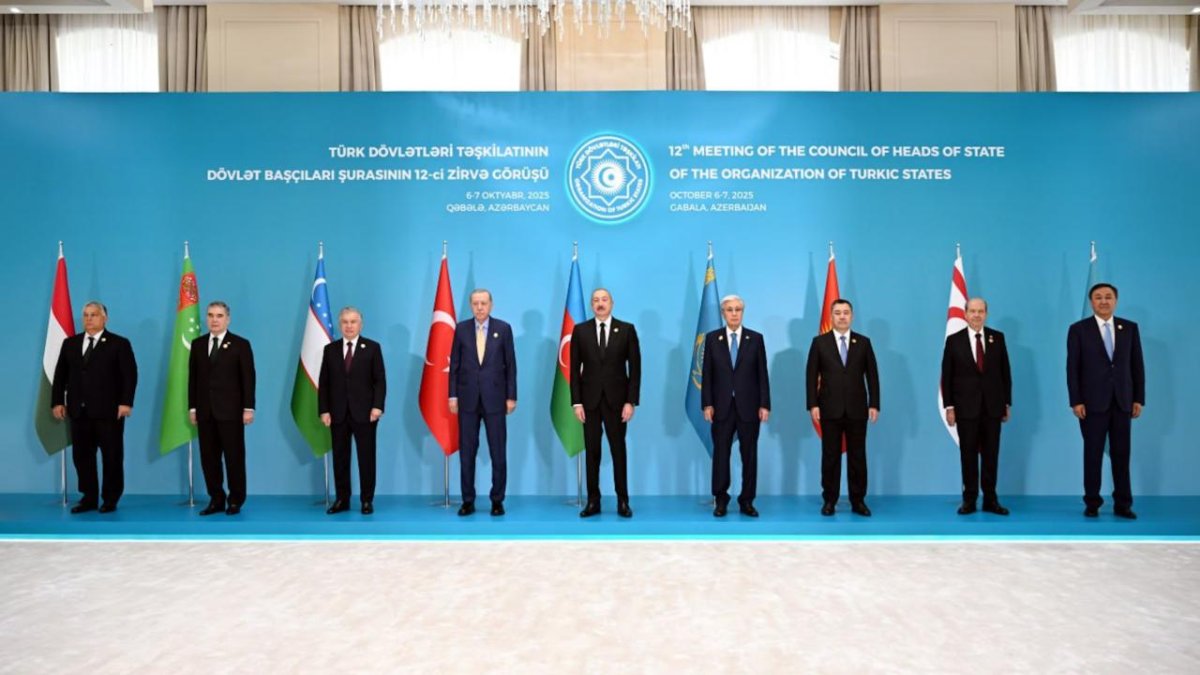
In recent years, the Organization of Turkic States has been transforming into an important geopolitical center from political, economic, and security perspectives.
The common historical and cultural roots uniting the Turkic states form the ideological and spiritual foundation of the Organization of Turkic States. This enhances the organization's internal solidarity and facilitates the integration process. The member countries of the OTS are located between Europe, Asia, and the Middle East, placing them in a position to significantly influence energy routes, trade routes, and the security balance.
The aforementioned points, in turn, are the reasons for the growing international interest in the organization. Particularly, the rich energy resources of countries like Azerbaijan, Kazakhstan, and Turkmenistan increase the organization's economic and political power. This transforms the OTS into an important actor in terms of energy security.
The Organization of Turkic States is located in a region of interest to powers such as Russia, China, the USA, and the EU. OTS member countries strive to protect their interests by engaging in bilateral and multilateral cooperation with these powers. In recent years, the Organization of Turkic States has transformed not only into a platform for cultural integration but also into an organization that cooperates in trade, transport, energy, defense, and diplomacy, gaining strategic weight on a global level.
For this reason, the OTS is expected to become one of the more significant geopolitical centers in the coming years. Important changes have been occurring in world politics in recent years. Against the backdrop of weakening globalization, diversification of power centers, and the increasing role of regional organizations, the Organization of Turkic States further strengthens its position. This organization, based on common history, language, religion, and culture, is no longer just a platform for cultural integration but is forming as a serious geopolitical actor. As is known, the foundation of the Organization was laid in 2009 with the Nakhchivan Summit. This body, initially operating as the “Turkic Council,” officially adopted the name Organization of Turkic States from 2021. Currently, Azerbaijan, Turkey, Kazakhstan, Kyrgyzstan, and Uzbekistan are members of the organization, while Turkmenistan and Hungary have observer status. This structure covers a vast geographical area extending from Central Asia to Anatolia, encompassing a total population of over 170 million, large energy reserves, and strategic transport routes.
These days, the leaders of the countries included in the Organization once again gathered in Azerbaijan, in the city of Gabala, one of the picturesque corners of our country.
The Gabala Summit of the Organization holds particular importance in terms of the statements made and the decisions adopted. The leaders' calls for peace drew special attention against the backdrop of ongoing conflicts in the modern world.
Farid Ahmadov;
Neftchala district