

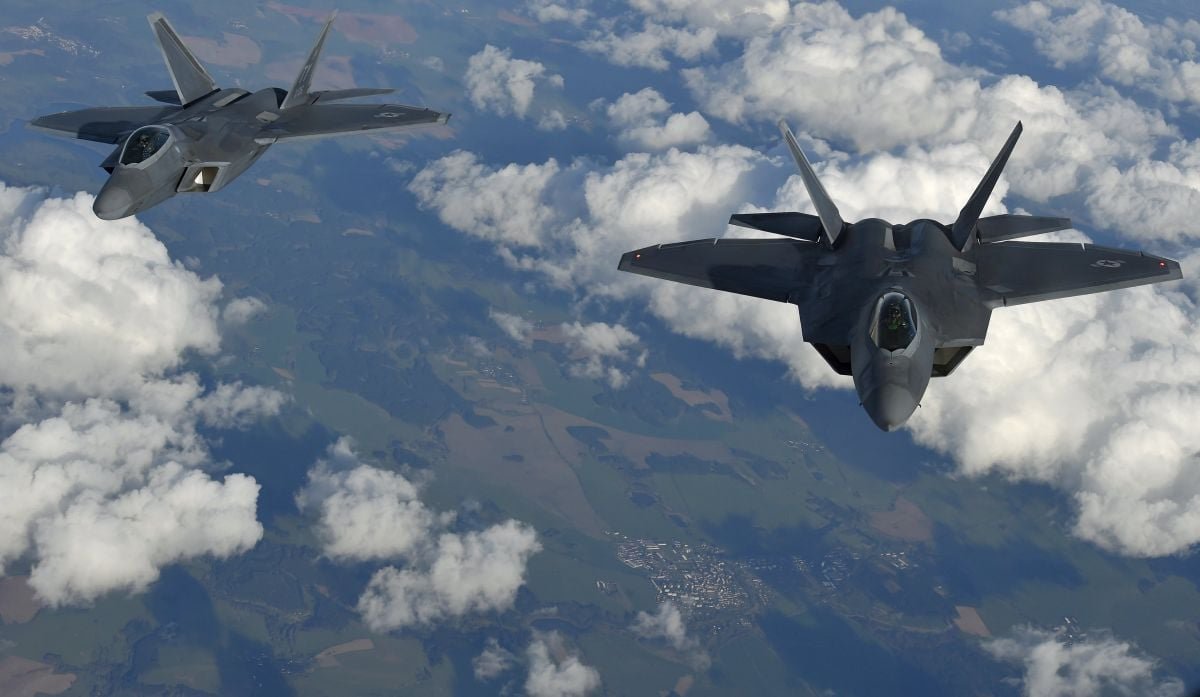
The F-22 Raptor, hailed by military experts as one of the world's finest fighter jets, is intended for the U.S. Air Force, and its design and operational characteristics render it unsuitable for carrier-based operations. The aircraft's features and the reasons for its unsuitability for carrier operations are examined in detail.
Redaksiya reports that the F-22 Raptor is primarily a fighter jet designed to achieve air superiority. Its airframe and landing gear are not built to withstand the extreme stresses of carrier operations, such as catapult launches and arrested landings. A carrier deck landing is essentially a "controlled crash," requiring a more robust structure.
The U.S. Navy's aircraft carrier USS Abraham Lincoln (CVN-72) boasts one of the world's most powerful air wings, comprising aircraft like the F/A-18 Super Hornet and the F-35C Lightning II. However, the F-22 Raptor, considered one of the best fighters globally, has never been part of carrier aviation. A primary reason for this is the F-22's stealth coating's vulnerability to the maritime environment, including saltwater, humidity, and wind. Maintaining the Raptor's stealth is challenging even on land bases, and on an aircraft carrier, it would be prohibitively expensive and technically risky. Instead, the Navy opted for the F-35C Lightning II, specifically adapted for carrier use with larger wings and reinforced landing gear. This aircraft has become the primary stealth fighter for carriers, while the F-22 remains solely a land-based "air superiority fighter." Although the F-22 has a tailhook, it is intended only for emergency stops on runways, not for regular use on aircraft carriers. Carrier-based fighters possess specially reinforced systems for numerous arrested landings.
In the 1990s, the F-22N Sea Raptor project was considered, which would have been a naval variant of the aircraft with modified wings. However, the U.S. Navy abandoned this idea due to its high cost and the risk of losing the aircraft's core characteristics. Furthermore, the F-22 is incompatible with carrier catapults; its nose gear is not designed for the rapid acceleration required for catapult launches. The F-22 Raptor was created for the U.S. Air Force and cannot withstand the stresses and conditions of carrier service. This is due to the aircraft's structural and operational limitations.