

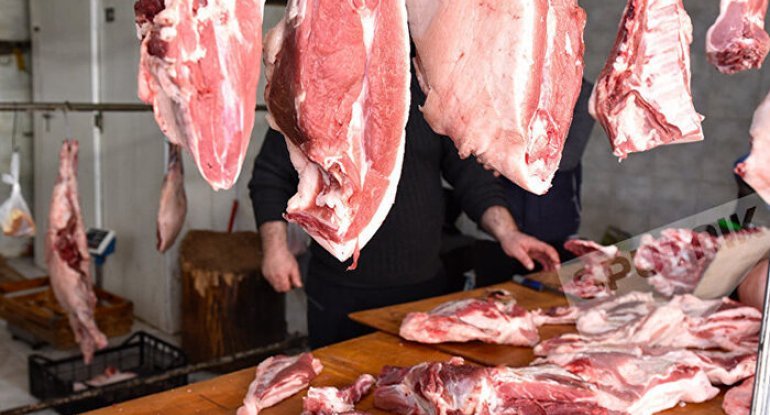
Meat prices in Baku have risen again. Since last week, the price of beef has significantly increased in many markets and butcher shops in the capital. Currently, a kilogram of bone-in beef is sold for 18 manats, and boneless meat for 22 manats. Butchers attribute this price hike to the closure of livestock markets and disruptions in the supply chain. Buyers, meanwhile, are already calling meat prices "close to fantastic levels." Now, questions are on everyone's mind: how long will this price increase last? Are the steps taken further increasing prices instead of stabilizing them? Most importantly, will red meat now be completely removed from the tables of ordinary families?
The editorial office presents an article from the "Kaspi" newspaper on the topic:
Have we been late in making the decision?
Akif Nasirli, chairman of the Center for Liberal Economists, states that against the backdrop of the widespread outbreak of foot-and-mouth disease in the country, a price increase in the meat market was inevitable: "In fact, the closure of markets and quarantine measures are the main means to break the chain of disease transmission. The incubation period for foot-and-mouth disease is approximately 7-15 days, meaning 10-15 days are sufficient to break this chain. However, it seems that the steps taken in this direction have been somewhat delayed. If this process had been implemented from October 10, the situation could have stabilized by October 20-25, and losses could have been significantly reduced. But the measures started a bit late."
According to the expert, every decision has both positive and negative sides. The quarantine imposed due to foot-and-mouth disease is no exception: "Since markets are closed, farmers face difficulties selling animals. Entrepreneurs involved in meat sales are forced to go door-to-door to buy animals. This creates additional costs and increases the prime cost."
"The price increase cannot be long-term"
Akif Nasirli believes that this price increase cannot be long-term: "If this situation prolongs, very serious negative consequences will emerge. Because even if local meat becomes more expensive, the population does not go without meat. Imported frozen or fresh meats are available as alternatives, and they are cheaper. Once the population gets used to these products, especially the lower-income segment, they will not return to local meat, remaining consumers of imported meat. This will lead to customer loss for local producers and butchers."
The expert adds that as a result, two opposing pressures are forming in the market: "On one hand, production decreases due to foot-and-mouth disease, which creates upward pressure on meat prices. On the other hand, the increasing demand for imported meats and the loss of local customers create downward pressure in the market. Time will tell which force will prevail."
An invisible force in the market
Agricultural expert Mircavid Hasanov says that due to foot-and-mouth disease, not only have sales stopped, but purchases have also decreased. People are hesitant to buy meat and dairy products. According to the expert, in this situation, price increases contradict economic laws, because normally, when demand for a product decreases, its price should also fall: "However, the opposite is happening here. An invisible force seems to control the meat market in Azerbaijan. Sometimes prices rise without any justification. Yet, recently, a lot of frozen meat has been imported into the country from abroad - from Mongolia, India, Russia. These are quality products. In such a case, when cheaper meat enters the market, prices should drop, but for some reason, they don't. For example, Mongolian lamb is sold for 12 manats per kilogram in the market, but the price of local lamb meat does not fall below 21-22 manats per kilogram," Hasanov emphasizes.
Crisis deepens in the meat market
"Restaurants buy Mongolian lamb"
The specialist believes that the public currently does not trust imported meat products: "Not eating frozen meat is just a stereotype. In reality, meat consumption in the country mostly occurs in catering establishments. For example, if a butcher shop sells four lambs a day to ordinary citizens, a restaurant buys 20 lambs. Many restaurants are already buying Mongolian lamb. This means that since local lamb is not being sold, the price should fall, but this is not happening."
According to Mircavid Hasanov, prices will gradually decrease once the situation with foot-and-mouth disease normalizes: "Currently, most farms have the disease, and sales have decreased. But this is a temporary situation. When the situation improves, prices will stabilize. Moreover, the impact of cheap meat imports from abroad will become apparent. This is somewhat similar to the initial arrival of Chinese cars in the country. Previously, everyone criticized them, but now Chinese cars are sold everywhere. Trust in frozen meats will also develop over time. I have inquired about meats from Mongolia; they are very high quality and organic. Animals are raised in natural conditions, and no food additives are used," the expert notes.
Both costs and risks have increased
Economist Khalid Karimli emphasizes that restrictions imposed on markets due to the widespread animal disease reduce the supply of beef: "According to market laws, when supply decreases, prices increase. Current restrictions reduce the number of animals brought to market, which leads to price increases. At the same time, this situation hinders the operation of traditional livestock markets and changes the competitive environment. This is an additional price-increasing factor. On the other hand, buyer behavior is also changing. Due to the risk of disease, people prefer to buy cut meat from stores rather than markets. This increased demand directed towards stores also raises prices. Consequently, the rise in beef prices also increases demand for fish and chicken meat, and this does not go without affecting the prices of those products."
According to the expert, how long the price increase will continue will directly depend on the course of the epidemic: "If the disease is brought under control in a short period, prices may gradually stabilize. But if the disease persists for a long time, this will lead to a more long-term price increase in the meat market."