

Azerbaijan's economic growth rate in the first half of 2025 continues with a lower indicator compared to Armenia, Georgia, Turkey, and Iran.
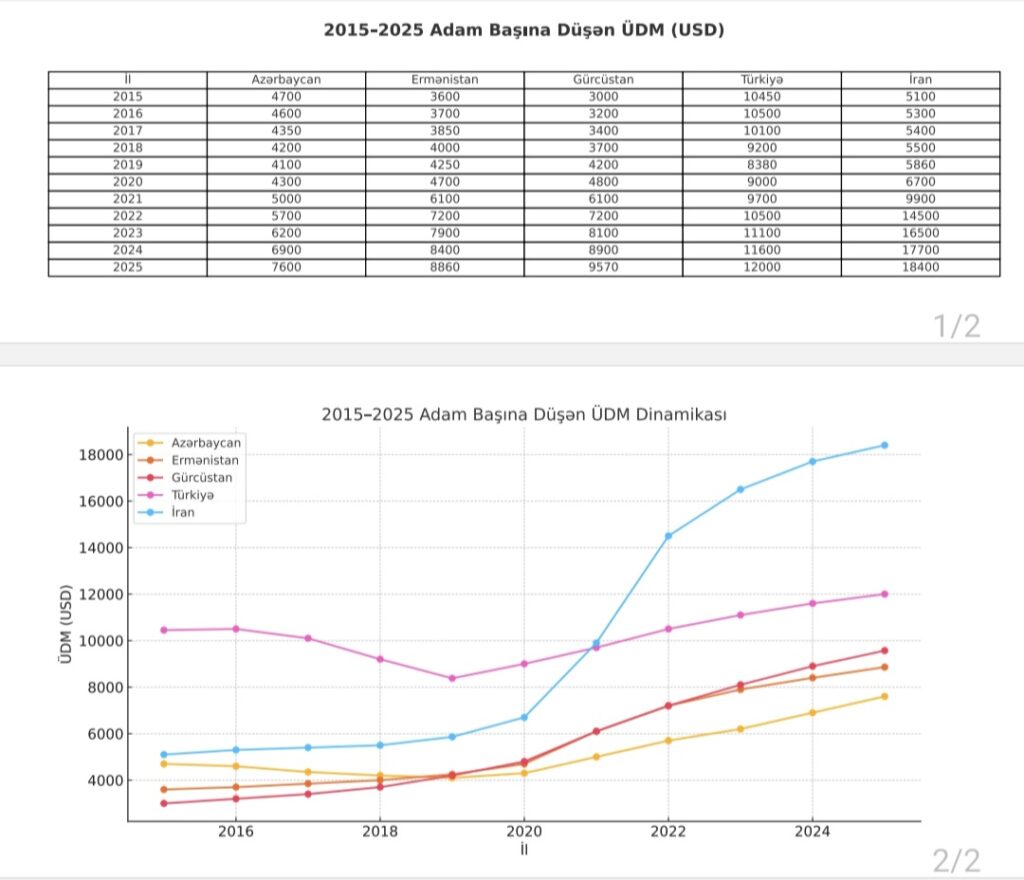
According to "Redaksiya's" research, in terms of per capita gross domestic product (GDP), Azerbaijan this year with 7,600 US dollars lags behind Armenia (8,860 USD), Georgia (9,570 USD), Turkey (12,000 USD), and Iran (18,400 USD). While Azerbaijan's growth since 2015 amounted to +2,900 dollars, this indicator was +6,570 in Georgia, +5,260 in Armenia, and +13,300 dollars in Iran.
There are five main reasons for the low statistics:
1. Oil and gas dependency and weakening in the energy sector
60–66 percent of the economy is dependent on the oil and gas sector. At the beginning of 2025, the decrease in oil production and stable energy prices weakened the growth rate. The weak dynamics in the oil sector also hampered overall GDP growth. Since Armenia and Georgia rely more on service and trade sectors, their recovery process is more agile.
2. Weak share of the non-oil sector
Sectors such as ICT, agriculture, light industry, and tourism have not yet reached their full potential. Despite state support, the share of these sectors in GDP is low. For example, the share of ICT is only 1.8 percent. In Georgia, the tourism and service sector accounts for more than 20 percent of GDP. Armenia, on the other hand, shows significant progress in ICT and financial technologies.
3. Slow pace of economic diversification
Although there are state programs for "green energy", technology, and agricultural sectors, these initiatives have not yet reached the results stage. The main part of foreign investments is still directed towards the energy sector, while non-oil sectors cannot attract sufficient support.
4. Limited utilization of regional trade and transit opportunities
Georgia and Armenia are playing an active role in the Russia–Iran–Asia transit line. Georgia earns significant profits from transit with China and Central Asia and from port revenues. Armenia, on the other hand, is experiencing an economic revival with the influx of Russian-capitalized companies. Although Azerbaijan is a transit country, the share of transport revenues in its GDP is still weak.
5. Weak coordination between public and private sectors
Although plans for industrialization and technological development exist, their coordinated and efficient implementation is weak. Although an increase in non-oil exports is observed, this increase does not significantly affect short-term GDP indicators.
Conclusion:
Azerbaijan's economic growth lags behind regional countries due to structural dependencies, weak diversification, limited transit revenues, and poor development of non-oil sectors. For long-term sustainable growth, a fundamental renewal of the economic model is needed.
Fərid Əlizadə