

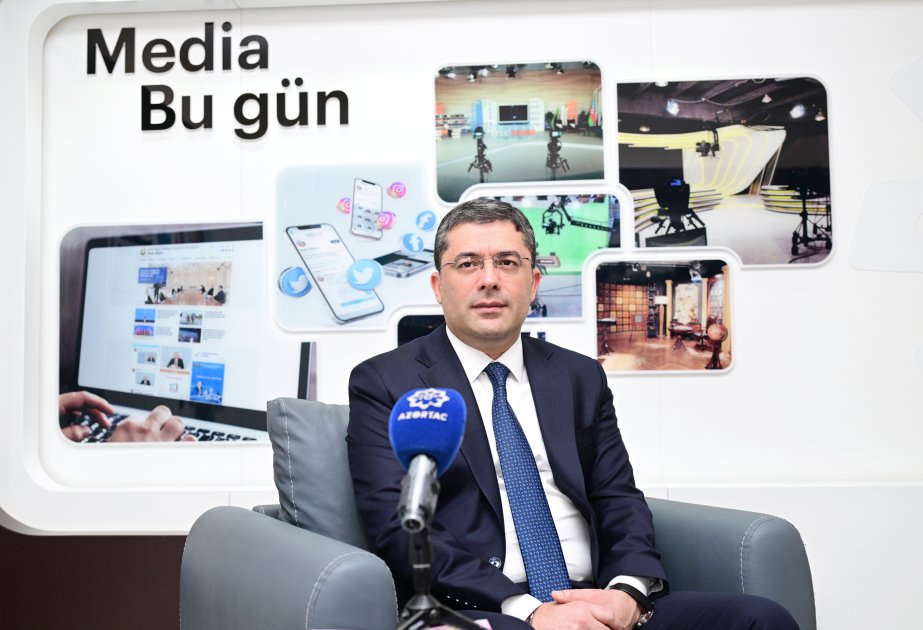
The Decree “On Deepening Reforms in the Field of Media in the Republic of Azerbaijan” signed by President Ilham Aliyev on January 12, 2021, laid the foundation for a new stage in the development of the country's media and led to the creation of the Media Development Agency of the Republic of Azerbaijan. AZERTAC interviews Ahmad Ismayilov, Executive Director of the Media Development Agency of the Republic of Azerbaijan, about the agency's activities over the past five years, the progress of media reforms in the country, and the tasks ahead.
- Mr. Ahmad, looking back at the five years of the Media Development Agency's activity, what points would you like to emphasize?
- Reflecting on the five-year phase of media reforms implemented in Azerbaijan, we can confidently say that systematic steps have been taken to fulfill each of the set tasks, and practical results have been achieved in modernizing the country's media ecosystem and adapting it to new trends. Supporting media development, increasing professionalism in this field, and stimulating digitalization, while simultaneously enhancing public trust in the media, are important factors that constitute the essence of the reforms. The foundation of the achievements lies in the state's strategic approach to information policy and the constant support provided by the President to the media's activities, both in ensuring information for society and in exercising public oversight. This is of exceptional importance in the process of implementing concrete result-oriented reforms with greater confidence. At the same time, the conceptual approach and solidarity of the country's media community and society, who understand the importance of the trend of media recovery and modernization, are an indicator of the work done over these years.
It is known that the President demonstrated the state's sensitive approach to improving the information provision of society by signing the Decree “On Deepening Reforms in the Field of Media in the Republic of Azerbaijan” shortly after our glorious victory in the 44-day Patriotic War. The innovations introduced as a result of the Decree have created conditions for stimulating the activity of Azerbaijani media, which serves to inform society objectively and professionally based on the principles of transparency and citizen satisfaction, and have spurred the application of global information environment principles such as modernization, rationality, widespread use of advanced technologies, and tracking leading trends, as well as innovative approaches. Stimulating the application of new information and communication technologies and innovations in the media sector, organizing the implementation of projects of public interest for citizens and society, and coordinating the activities of state bodies and institutions, local self-government bodies, legal and natural persons in the relevant field have been among the main priorities of the Media Development Agency.
Global digitalization processes have led to the formation of a new and dynamic media environment worldwide. In order to ensure that the national media space develops in line with modern trends and that media messages are promptly and fully delivered to both domestic and foreign audiences, the reforms implemented in the local media space essentially involve measures aimed at renewing the organizational, legal, and economic foundations of activity in this field, as well as more effectively regulating issues such as the acquisition, preparation, transmission, production, and dissemination of mass information.
- The Law “On Media,” which is a key component of media reforms, is considered a new opportunity and a new stage for the development of Azerbaijani media. In general, what can you say about the results achieved during the reforms, as well as the short-term goals?
- The Law “On Media,” which serves as a "roadmap" for the media reforms implemented in Azerbaijan, has proven its practical significance in strengthening and protecting the country's information environment over the past period. We would like to recall that before the draft Law was submitted for discussion in parliament, it was presented at leading media entities, and discussions were held with the participation of hundreds of journalists, media representatives, and experts. Public discussions of the Law were also organized at the parliamentary level on several occasions. Many experts rightly consider the Law “On Media” to be a legal act that has generated great interest and extensive discussion in society, second only to the Law on the State Budget.
The purpose of the Law “On Media” is to ensure the security of our country's information space, to promote the development of local media, to improve the information environment and increase its competitiveness, and to create conditions for enhancing the prestige of the journalism profession. After the Law came into force, the implementation of the “Rules for maintaining the Media Register” was ensured, and the process of systematizing information about media entities and journalists was legally regulated.
It is noteworthy that on February 8, 2022, the same day he approved the Law, the President signed a Decree that included journalists in the list of individuals eligible for preferential mortgage loans. This step is a clear example of the state's high attention and care for journalistic labor by placing journalists, who perform the honorable profession of providing objective and unbiased information to society, on par with other valuable professionals.
As you know, starting this year, the period of exemption from income (profit) tax for income earned by media entities from their activities has been extended. These economic benefits for the media began to be applied from January 1, 2023. If we look at the content of the state's decisions in the media sector, we see that strengthening the economic stability of Azerbaijani media, and the development of independent, strong media capable of operating at the level of modern demands, while remaining committed to statehood traditions and guided by the national interests of our people, have always been a priority. The Media Development Agency also bases its work on strengthening the economic independence of media entities, forming a new economic model in this field, and stimulating the application of new information and communication technologies and innovations. We would like to emphasize that continuing this fundamental approach to media reforms is among our priority goals.

- Over the past five years, steps have been taken to enhance journalistic professionalism, and media support projects have been consistently implemented. Will this direction be a priority for the next stage?
- The strength of Azerbaijani media and its ability to provide people with high-quality public interest information are directly related to both factors you mentioned: increasing journalistic professionalism and strengthening media entities. In this regard, this direction will continue to be relevant in the future. Our country is systematically facing disinformation threats; the intensity of actions aimed at polluting our information environment in the modern era has increased compared to previous years. As the President emphasized, as Azerbaijan's prestige grows and it takes its rightful place on the international stage, smear campaigns against it also intensify. Azerbaijani media should not consider its work complete by merely informing the domestic audience; it also has the important mission of responding to disinformation threats and conveying the truths about our country to the world. Approaching this issue from this perspective, we can consider increasing the competitiveness of media entities and further professionalizing our journalists as extremely important factors.
In accordance with its charter, the Agency implements media support projects in several areas to stimulate the development of media in Azerbaijan, including promoting high-quality journalism through development programs with the participation of local and international experts, strengthening human resources in the relevant field and expanding employment opportunities, and creating a favorable environment for regional media. To improve the knowledge and skills of media representatives, various events and development programs are implemented throughout the year to develop professional and specialized journalism, with the participation of local and foreign experts. Within the framework of the successful partnership between the Media Development Agency and ADA University, last year alone, training sessions were organized for nearly 250 media representatives with local and foreign experts as trainers on topics such as "History of Azerbaijani Press," "Media Ethics," "Narrative Formation: Effectiveness in Strategic Communication and Public Relations," "Data Journalism," "Media, Myths, and Misconceptions: How to Effectively Use Artificial Intelligence in Media," "Application of Artificial Intelligence in Media," and "Storytelling": New Narratives and Current Trends in Modern Journalism."
Last year, in cooperation with the Media Development Agency and Euronews, one of Europe's leading news networks, Euronews Academy was launched in Azerbaijan. This academy offers high-quality training programs aimed at creating in-demand content in the ever-changing media environment, effectively applying modern media trends, and understanding new media techniques that align with reader habits. Training programs consisting of a total of 3 modules on "Digital Journalism" and "TV and Live Journalism" were delivered for media representatives, students majoring in journalism and communication, and those interested in the media field by the international educational platform.
We would also like to note that there is no media entity in Azerbaijan that has been left out of the training programs implemented by the Agency over the past five years. The increasing statistical indicators each year provide grounds to say that the enhancement of journalistic professionalism is ongoing, and media employees will continue to acquire new knowledge and skills. At the same time, it has become a tradition to conduct training for relevant specialists to effectively develop communication strategies of state bodies (institutions), increase the knowledge and skills of public relations personnel, improve the work of press services, adapt their activities to modern communication systems, and effectively implement mechanisms for informing the public in possible crisis situations.
- The implementation of support projects for media entities is already taking on new meaning. What can you say about this?
- We would like to remind you that the Agency organizes competitions to support the activities of media entities, based on the principles of the "Concept of State Support for the Development of Mass Media in the Republic of Azerbaijan." The goal is to strengthen the economic independence of media entities, improve their activities, and ensure the implementation of projects of importance to the state and society. State support mechanisms for the media are constantly being improved in line with the demands of the times and incorporate new elements. While previously social networks were seen as competitors to professional journalism, today the development of IT technologies, especially the widespread dissemination of artificial intelligence-based content, requires a more flexible approach to the media. The media, in turn, must take advantage of the support provided to keep pace with modern trends. We would also like to inform you that for the second year now, together with the Audiovisual Council, we have been organizing competitions for the production and distribution of audiovisual products on a state order basis. Our goal is to promote the production and distribution of audience-oriented content tailored to target audiences in the new media environment. Increasing the competitiveness of educational materials, content diversity, and creativity have been identified as key priorities. Our aim is to increase the number of informative and socially valuable materials, while simultaneously encouraging television channels to produce innovative, multi-format, and creativity-based content.
- Mr. Ahmad, one of the new media trends formed not only in our country but also on the international stage in recent years is the media forums held in Shusha. We would like to hear your thoughts on this as well.
- The personal participation of President of the Republic of Azerbaijan Ilham Aliyev in the Shusha Global Media Forums, which have become a think tank for world journalists, and his answering numerous questions from media representatives, is a significant event in conveying the voice of truth of our state to the world, as well as an exceptional manifestation of the state's attention and care for the media. To analyze the trends observed in the new media environment from a broad spectrum, expand international cooperation in the media field, track leading trends in this area, and explore the mechanisms for applying the opportunities created by innovative evolution for creative industries, the "New Media in the Era of the 4th Industrial Revolution" Shusha Global Media Forum, consisting of 4 panel sessions, was held in Shusha from July 22-24, 2023. Within the framework of the Forum, renowned and influential media leaders and experts from around the world discussed issues of great international relevance in the media and information-communication fields during panel sessions. Additionally, various international projects were presented, exhibitions were held, and cultural events and training sessions took place. Numerous cooperation agreements were signed during the Forum. The 2nd Shusha Global Media Forum on "Exposing False Information: Combating Disinformation" was organized from July 20-22, 2024, with the participation of President of the Republic of Azerbaijan Ilham Aliyev. The main goal of the Forum was to discuss the global media agenda and create a joint action platform against disinformation.
Four panel discussions were held on the dates mentioned to explore opportunities for applying innovative methods in the fight against disinformation, considered one of the main threats to global stability, to analyze proactive strategies, to determine the role of the media and effective solutions in this direction, the impact of artificial intelligence on reality, media, and disinformation, and the importance of media literacy in combating disinformation. A presentation on "Solidarity for a Green World - COP29" was also given, along with a meeting of the Executive Committee of the Alliance of Turkic News Agencies (ATNA), and parallel events on various topics. Furthermore, cooperation agreements were signed between the Azerbaijan State News Agency (AZERTAC) and four foreign news agencies: APS of Algeria, APS of Senegal, APP of Pakistan, and MTI of Hungary. The 3rd Shusha Global Media Forum on "Digital Transitions: Strengthening Information and Media Resilience in the Age of Artificial Intelligence" was organized from July 19-21, 2025, with the participation of the Head of State. Three panel sessions were held on "Innovative Approaches: Media Literacy in the Digital Age," "Media Literacy as a Guarantee of Information Security," and "How the Evolution of Social Media Affects Public Trust: Within the Scope of Media Literacy," as well as a one-on-one meeting on "Journalism in the Age of Artificial Intelligence: Protecting Truth Amidst Automation" and various parallel events. An open-air exhibition dedicated to the rich cultural heritage and historical monuments of Karabakh and other parallel events were organized as part of the Forum. In addition, agreements were reached on strategic media partnerships between the "AnewZ" channel, CCTV+ (the news service of China Central Television), and the Television and Radio Complex of the President of the Republic of Kazakhstan. Furthermore, a Memorandum of Understanding on cooperation was signed between the Azerbaijan State News Agency (AZERTAC) and the National Information Agency of Uzbekistan (UZA). I would like to emphasize that interest in all the forums held is increasing year by year, which plays an important role in the development and sustainability of the media landscape and in conveying Azerbaijan's truths to the world.
- Speaking of the media forums held in Shusha, it would be interesting to hear your thoughts on the international relations of the media.
- The dynamic impact of the Shusha Global Media Forums is evident in the strengthening of our international relations. Last November, the first D-8 Media Forum was held on the theme "Promoting Dialogue, Cooperation, and Regional Solidarity," with the participation of heads of media-responsible bodies and leading media entities from D-8 member states, other high-ranking officials, and renowned experts in the field. To discuss improving information exchange at the regional and international levels, strengthening cooperation in the media sector, forming joint mechanisms for combating disinformation, and promoting joint projects in digital media and sharing experiences, two panel sessions were held on "Responsible Journalism and Digital Innovation" and "Strategic Communication and Crisis Management," as well as a workshop on "Media Ethics in a Digitalizing World: Technologies, Trends, and Narratives." Within the framework of the D-8 Media Forum, which was attended by foreign representatives from eight countries and the Organization's Secretariat, a presentation on the D-8 Center of Media Excellence was made, and the Baku Declaration on joint development and cooperation in the media sector among member states was signed.
On November 27-28, 2025, the 7th meeting of the ministers and high-ranking officials responsible for media and information of the Turkic States Organization, and the 12th meeting of the Organization's Working Group on Media and Information were held. Simultaneously, the Media Forum of the Turkic States Organization, consisting of two panel sessions on "Resilient and Preventive Steps Against Increasing Global Information Threats in the Modern Era: The Case of the Media Ecosystem of Turkic States" and "Opportunities for Cooperation Among TDT Member States in the Digital Media Environment," was organized. Within the framework of the Forum, a representative of the WUF13 Azerbaijan Operating Company also made a presentation on "Media Opportunities within the Thirteenth Session of the World Urban Forum (WUF13)."
On December 5 last year, the Azerbaijan-Georgia Media Forum was held on the theme "The Role of Media in Shaping Public Trust and Information Security," consisting of two panel sessions on "Strengthening the Media Ecosystem to Ensure Information Security" and "Joint Cooperation in Enhancing Journalistic Professionalism and Public Media Literacy" to strengthen bilateral cooperation in the field of media and communication between Azerbaijan and Georgia.
- One of the important innovations brought about by media reforms is media literacy and the further development of public thought in this direction, as well as the strengthening of educational measures. Mr. Ahmad, why is media literacy so important for any society?
- Forming a healthy media environment in the context of digital transformation, reducing disinformation risks, and strengthening media literacy in society have been priority areas of the Agency's activities, and systematic, multifaceted measures are being taken to increase media literacy. To develop the mindset in society regarding media literacy, ensure information security, strengthen the fight against disinformation, increase the effectiveness of measures taken in this area, and expand coordination and cooperation among various parties, we have been organizing the "Media Literacy Week" every December for the third year now. As part of the preparations for the week, the Agency carries out a series of events to form a responsible stance among young people living in the regions in the media and information environment, enhance their knowledge and skills in determining the reliability of information, and strengthen solidarity in the fight against disinformation. For example, last year alone, TOT (Training of Trainers) seminars were organized for teachers in 12 general and secondary education institutions in Baku, including 2 pilot schools. In November-December, these teachers conducted informational sessions and open lessons. To expand the regional scope of media literacy activities and increase attention to this area, a series of events were held in the Nakhchivan Autonomous Republic within the framework of "Media Literacy Week." As media literacy is a skill at the center of social, cultural, and economic activities in a broad sense, to achieve effective results in the work done in this direction, this year's Week was organized in partnership with 13 institutions, including state bodies (institutions), private companies, and academic institutions, to promote inter-sectoral cooperation. Within the framework of the Week, foreign guests from Turkey, Uzbekistan, Kazakhstan, Hungary, Pakistan, and Albania visited our country to study international experience and exchange knowledge and experience. Training sessions were organized for young people with the participation of the aforementioned foreign experts on the topics "Characteristics of Manipulation: Media Content in the Context of Artificial Intelligence" and "Digital Hygiene and Online Safety: Protecting Personal Information, Accounts, and Reputation in the Digital Environment." As part of various educational events promoting informal learning, an intellectual game was held for the first time with the participation of hundreds of young people. Increasing media literacy in society directly influences each individual's more critical and responsible approach to information production and consumption processes, the development of a healthy media environment, and the ensuring of information security in society. At the same time, media literacy plays a vital role in combating false and misleading information that hinders the sustainable development of society.
- Mr. Ahmad, last year was memorable for significant events for Azerbaijani media, which celebrated its 150th anniversary. What can you say about future prospects?
- Last year, the jubilee events of the national press were held in a series and were celebrated at a high level. Journalists were awarded state honors by the President. At the same time, the establishment of the jubilee medal "150th Anniversary of the National Press of Azerbaijan (1875–2025)" is considered a manifestation of the state's sensitive attitude towards the development of national journalism. Immediately after President Ilham Aliyev's call at the 80th anniversary of ANAS, where he noted that journalists bear special responsibility for the literary language, a conference on "Correct Application of the Norms of the Azerbaijani Literary Language in Media" was held on November 7, 2025, jointly organized by the Media Development Agency and the Azerbaijan Press Council, with the aim of promoting the correct, fluent, and accurate use of the Azerbaijani language in media in accordance with literary norms, developing language culture, and contributing to raising speech standards in the media. Within the framework of the conference, panels were organized on "The State of Adherence to the Norms of the Azerbaijani Literary Language and Speech Culture in Television and Radio," and "Rules for the Use of the Azerbaijani Language in Print and Online Media: Problems and Solutions." Practical conclusions were drawn from the discussions. The Head of State once again mentioned this in his interview with local television channels some time ago regarding the protection of our mother tongue. The correct use of the Azerbaijani language in the media imposes responsibility on journalists, and as an Agency, we must further increase our efforts in this direction.
As mentioned, combating disinformation will always remain a priority for Azerbaijan. First Vice-President of the Republic of Azerbaijan Mehriban Aliyeva, in her speech at the conference "Youth at the Forefront of Climate Action" held in the Green Zone within the framework of COP29, emphasized that hypocrisy and double standards are clearly evident in relation to the international environmental agenda, stating that "As the host country of COP29, Azerbaijan has faced an unfair wave of attacks, false stories, and double standards due to considerations far removed from environmental issues." It would be naive to say that such double standards have ended, and therefore, Azerbaijani media must always be principled against attempts to pollute our country's information environment. In short, modernization, strengthening in information competition, and conveying our country's voice of truth to the world at a high level will remain the main goals of deepening media reforms.