

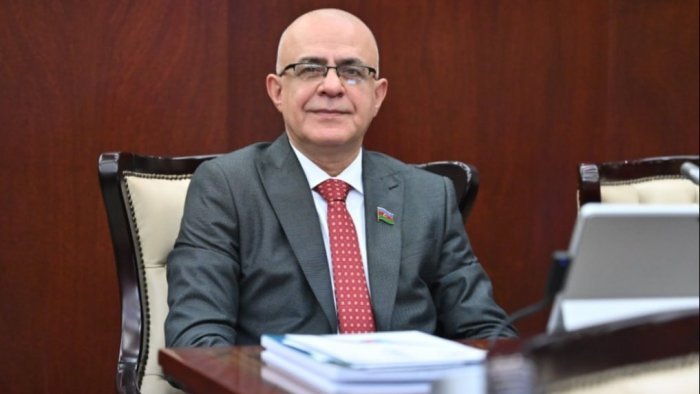
“Official Baku and the Élysée Palace are interested in seeking new dialogue opportunities within the framework of parliamentary diplomacy. In this regard, mutual visits of both Azerbaijani and French parliamentarians in the future are not ruled out.”
The editorial office reports that these views were expressed in an exclusive statement to XQ by Elchin Mirzabayli, a member of the Milli Majlis and the Committee on International Relations and Interparliamentary Ties. According to him, our country is ready to normalize relations with France: “Although the Azerbaijani Foreign Ministry's statement on November 7, “A New Page in Relations with France,” and information about possible visits by deputies were evaluated as a positive signal, the French Senate's adoption of another biased resolution against Azerbaijan on November 16 dealt a serious blow to the dialogue. This indicates that the institutional fragmentation in Paris-Baku relations has not yet been overcome.”
“The new geopolitical order formed in the South Caucasus after the Second Karabakh War necessitated not only the re-evaluation of existing relations by regional countries but also by foreign powers. The tension observed particularly between France and Azerbaijan stemmed both from the changing realities in the region and from the imbalance arising from Paris's relations with Armenia,” Elchin Mirzabayli stated.
The deputy noted that although relations sometimes escalated to open confrontation, certain softening trends emerged against the backdrop of President Ilham Aliyev's meetings with Emmanuel Macron in Tirana. However, emphasizing that it is too early to call this dynamic normalization, E. Mirzabayli stated that for the process to be sustainable, not only political will but also the elimination of long-standing stereotypes and lobby influences are required: “Information about mutual visits of both Azerbaijani and French parliamentarians indicates that the parties are interested in seeking new dialogue opportunities within the framework of parliamentary diplomacy. But I must also note that the resolutions of the French Senate confirm that the influence of the Armenian diaspora and lobby organizations in Paris is still strong.”
How dependent are Azerbaijan-France relations on Azerbaijan-Armenia relations?
According to the committee member, speaking on this matter, although a political dialogue historically existed between Azerbaijan and France, Paris's unilateral stance regarding Armenia in recent times has severely damaged mutual trust: “The Armenia factor is one of the main points of contention in France-Azerbaijan relations. Paris's long-standing special relations with Yerevan and diaspora influence have played a significant role in shaping this policy.”
According to the deputy, the signing of an Azerbaijan-Armenia peace agreement could positively impact relations between the two countries, but this cannot be considered sufficient for full normalization. This is because the problems are not solely related to Armenia. At the root of the issue lies France's view of the region as a sphere of geopolitical influence, outdated stereotypes about Azerbaijan, and Paris's own internal political dynamism.
The deputy also noted that if a peace agreement is signed, the reduction of tension in the region could weaken Paris's grounds for a tough stance, and cooperation between our country and the European Union would become more stable. However, it should not be forgotten that France-Azerbaijan relations are going through a complex phase where multifaceted influences intersect. The regular biased resolutions of the French Senate indicate that the political environment in the country is not stable, and there is still some distance to go for full normalization. This means that while there is a high probability that a final Baku-Yerevan peace will positively impact Azerbaijan-France relations, the full smooth development of these relations will depend not only on regional realities but also on France's will to reshape its own policy.