

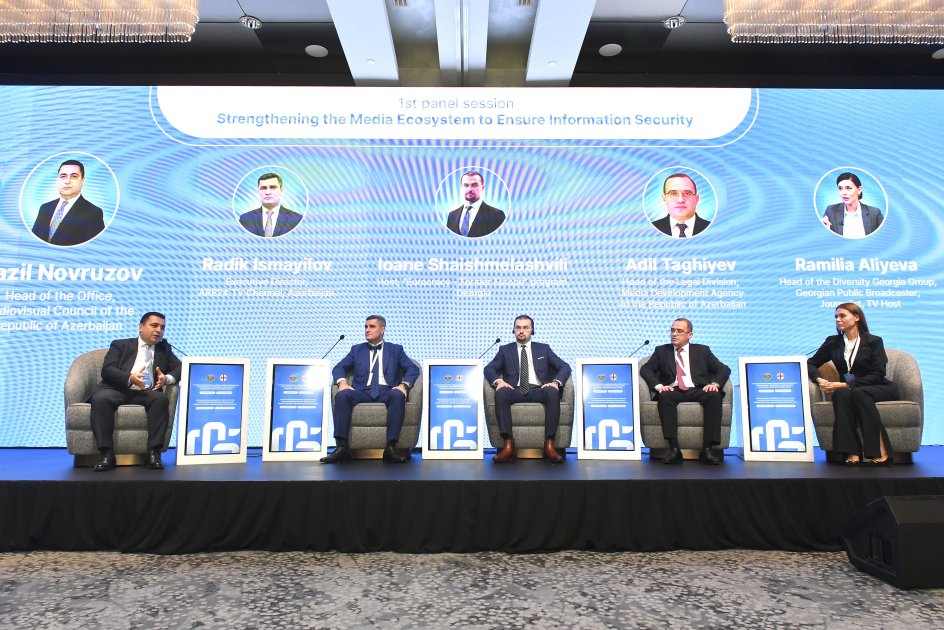
In Baku, within the framework of the Azerbaijan-Georgia Media Forum, the topic of “Strengthening the Media Ecosystem to Ensure Information Security” was discussed.
The news agency reports that in the panel session moderated by Fazil Novruzov, Head of the Audiovisual Council's Apparatus, a broad exchange of views took place on issues such as the multifaceted impact of technological evolution on the media environment, the protection of a reliable information environment, the transformation of social media into one of the main sources of information, and the establishment of more effective communication with various audiences through digital tools.
Radik Ismayilov, Executive Director of the "ARB 24" TV channel, noted that the rapid development of digital technologies, especially artificial intelligence, further complicates the process. On one hand, artificial intelligence accelerates information production, increases operational efficiency, and creates new opportunities for media activities. On the other hand, it makes the preparation of fake information, manipulative visual and textual materials extremely easy. This, in turn, makes it difficult to preserve honesty, accuracy, and reliability, which are the core principles of journalism.
“It has become significantly more difficult to accurately determine whether every piece of information presented is true compared to previous years. Access to information is expanding, but the ability to distinguish between true and false information is weakening. Therefore, increasing information literacy, strengthening fact-checking mechanisms, and protecting media ethics become special priorities. Today, disinformation is not just virtual manipulation; it is used as a real method that influences public consciousness, behavioral models, and decision-making processes. Therefore, as media organizations, specialists, and state structures of both countries, we must direct our attention to this area with greater sensitivity. Joint cooperation, mutual exchange of experience, educational activities, and the formation of new technological security standards must be established,” emphasized R. Ismayilov.
Ioane Shaishmelashvili, host of Georgia's “Eurocracy - Former Europe” program, drew attention to the fact that Azerbaijan and Georgia face the same information threats, stating: “Especially in recent years, the scale of disinformation campaigns in both countries has been rapidly expanding. The process has moved beyond the manipulation of individual news items and has become a dangerous tool used for the systematic shaping of public opinion.”
The host noted that the fact that most of the information disseminated regarding political processes in Georgia in recent years has been the target of disinformation is clear proof of this. “Our television organizations have been fighting in this direction for years and have gained considerable experience. However, it is evident that the scale of disinformation campaigns is growing, the topics are expanding, and the objectives are becoming more coordinated. I believe that the goal for both countries should be the same: strengthening defense mechanisms in the field of information security, increasing media literacy to reduce the spread of fake news, and applying new methods for identifying and neutralizing manipulative content produced by artificial intelligence. This is because the accurate informing of society today must be valued as a national issue, a security priority, and a strategic direction.”
Adil Taghiyev, Head of the Legal Department of the Media Development Agency, added that building a strong, professional, and reliable media ecosystem is not only the responsibility of journalists but also requires the proper functioning of the legislative framework and the clear legal framing of state-media-society relations. In Azerbaijan, media activities are regulated by certain laws and normative acts.
“The Law of the Republic of Azerbaijan 'On Media' defines the principles of media operation, the rights and responsibilities of journalists, the criteria for information dissemination, and the legal basis for editorial independence and media freedom. The law defines the procedures for obtaining, preparing, transmitting, producing, and disseminating information in the media sector, the status of media entities, their rights and responsibilities, the rights of journalists, media freedom, editorial independence, and the state's obligations in the media sector. Laws concerning media serve to increase transparency and accountability in information dissemination, protect journalists' rights and ensure their professional activities, prevent disinformation, and strengthen trust in the media environment, among other areas,” emphasized the Head of the Agency's Legal Department.
Ramilia Aliyeva, head of the “Colorful Georgia” project at Georgian Public Television, a journalist and TV presenter, noted that “ChatGPT” offers great opportunities for the media in terms of operational efficiency. In the modern era, characterized by a high intensity of news flow, systematizing information, editing texts, and conducting preliminary analysis in a short time saves journalists time and ensures the media entity remains agile in its information cycle. Furthermore, artificial intelligence helps improve text quality in terms of language, style, and structure, making professional presentations more fluent and readable. However, the media's cooperation with artificial intelligence is not limited to technical advantages; it is also a process that demands responsibility. In an era where disinformation spreads rapidly and visual and textual manipulations can be easily created, the use of artificial intelligence tools requires special ethical attention.
The panel session continued with discussions.