

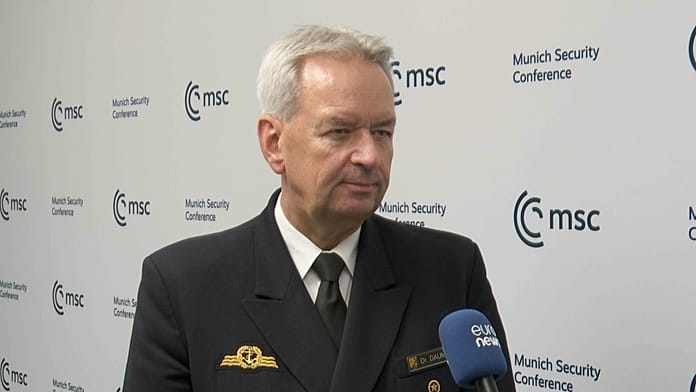
Germany is continuing its armament process, which is no longer limited to Earth. Last year, Defense Minister Boris Pistorius allocated approximately 35 billion euros for space capabilities. According to Inspector Thomas Daum, space has become a new battlefield.
Redaksiya reports that against the backdrop of changes in the global security landscape, space is no longer seen merely as an area for research and commerce, but also as a central pillar of Germany's national security and military deterrence.
According to Vice Admiral Dr. Thomas Daum, Inspector for Cyber and Information Domain of the German Armed Forces, space has now become a battlefield in itself. Currently, the Bundeswehr possesses eight to ten satellites, primarily for reconnaissance, including the SAR-Lupe and SARah systems, as well as for communication. However, this fleet is considered obsolete.
In an interview with Euronews at the Munich Security Conference, Daum stated that satellites are "important for the functioning of our terrestrial systems" and go beyond purely military use. He noted that "if the satellites fail, you cannot withdraw cash." There is a risk of "attacks on our systems in space."
Against this backdrop, a "day without space" – in other words, a large-scale satellite failure – would be "largely a disaster." Such an attack would intentionally disable satellites, leading to immediate consequences on the ground, severely disrupting critical infrastructure and essential services.
As in other defense sectors, Berlin's response is deterrence. In September of last year, Defense Minister Boris Pistorius pledged approximately 35 billion euros by 2030, with a portion allocated to space reconnaissance capabilities, known as "SPOCK," which the Bundeswehr has been using since the beginning of the year.
The system, built in cooperation between Finland's Iceye and Germany's Rheinmetall, is based on a network of radar satellites using synthetic aperture radar (SAR). Unlike optical satellites, they can capture images of the Earth's surface in any weather condition and at any time of day, regardless of cloud cover or darkness – tracking movements and changes on the ground.
For Daum, deterrence in space is based on the same logic as on land, at sea, or in the air: capability demonstrates intent. If you show that you can operate and interfere in orbit, you signal that the opponent's systems are not untouchable.
This does not necessarily mean shooting down satellites from the sky. In practice, so-called non-kinetic measures are often more relevant. For example, optical reconnaissance satellites can be temporarily "blinded" from the ground by jamming their sensors. These satellites rely on high-precision cameras or telescopes; disrupt the sensor, and the satellite cannot see.
Another method is to transmit jamming signals to disrupt communication satellites. The hardware remains intact, but its utility is diminished. Daum stated that "the effect is felt on the ground." "If a reconnaissance satellite cannot track the movement of your forces, you gain a tactical advantage."
There are also political reasons for these capabilities to be designed to prevent physical destruction. Germany joined the US-led Artemis Accords in 2023, committing to the principle of not creating space debris.
In practice, this means that an opponent's satellite cannot simply be shot down. Instead, the focus is on reversible measures – limiting or disrupting its use without leaving debris in orbit. For now, this remains the official line.
However, according to Daum, some political voices are beginning to question the so-called "zero debris" principle. He told Euronews that "just because we have the capability to destroy a system does not mean we will use it."
At the same time, he argues that demonstrating this capability sends a message. Signaling that "we have the same capabilities as our adversaries" affects the logic of punitive deterrence – the idea that an adversary considers the threat of retaliation.
Daum stated that "this can, of course, have a deterrent effect." "But it will ultimately require adjustments to our space security strategy – and that is a political decision."
In addition to reconnaissance, secure and reliable communication is also critical – both in peacetime and during crises. The Bundeswehr relies on satellite communication. For long-distance connections, it has so far relied primarily on geostationary satellites, using its own or leased capabilities.
For example, if a German warship is deployed from Europe to Africa, communication is routed through this infrastructure, Daum explained. The project known as "SATCOMBw Phase 4" is the largest space program in the history of the Bundeswehr. Its goal is to connect tanks, ships, aircraft, and troops worldwide via satellite communication – and in particular, to ensure operations on NATO's eastern flank, including the permanently stationed German brigade in Lithuania.
However, SATCOMBw remains a traditional system built around a few large satellites. It cannot be compared to constellations like Starlink, which consist of thousands of small, interconnected satellites in low Earth orbit. Instead of relying on a few high-value assets, Starlink operates a dense network of smaller, interconnected units.
This creates more entry points and significantly increases resilience and agility. The strategic value of such systems has become particularly clear in the war in Ukraine in recent years. Both Russia and Ukraine have used the satellite network operated by SpaceX, to varying degrees, especially for the coordination and control of drones.
Officially, Starlink services are not permitted for use in Russia. However, since 2023, Starlink terminals have begun to appear in Russian units and have allegedly entered the country through intermediaries in the Gulf or Central Asia. In the last two weeks, SpaceX has attempted to block Russian forces' access to Starlink services. Ukraine has stated that the restrictions have "significantly disrupted" Russian operations. Moscow has denied this, stating that there has been no impact on its drone warfare capabilities.